Phone:
(86)138-1388-1779
Physical address:
6296 Donnelly Plaza
Ratkeville, Bahamas.

Phone:
(86)138-1388-1779
Physical address:
6296 Donnelly Plaza
Ratkeville, Bahamas.
Pick the wrong racking system and you either pay to refrigerate empty aisles or run out of pallet positions the moment volume spikes.
The decision between drive-in racking and selective racking comes down to two questions: how many different products do you store, and how fast does each pallet move?
Drive-in racking packs pallets four to ten deep in a single lane and trades individual pallet access for maximum density. Selective racking gives every pallet its own position with full access at all times, at the cost of far more aisle space. Neither system is universally better.
This guide covers how each system works, its real advantages and limitations, how the two compare head to head, and how to match the right system to your actual SKU count and turnover rate.
Drive-in racking is a high density pallet storage system where a forklift drives directly into the rack structure instead of stopping at a fixed aisle. Pallets rest on continuous support rails that run the depth of the lane, typically four to ten pallet positions, rather than on individual beam levels.
Loading and retrieval happen from the same end of the lane, so the system runs on a last in, first out basis. One forklift aisle can serve an entire block of drive-in racking systems, which is what allows this method to reach such high storage density.

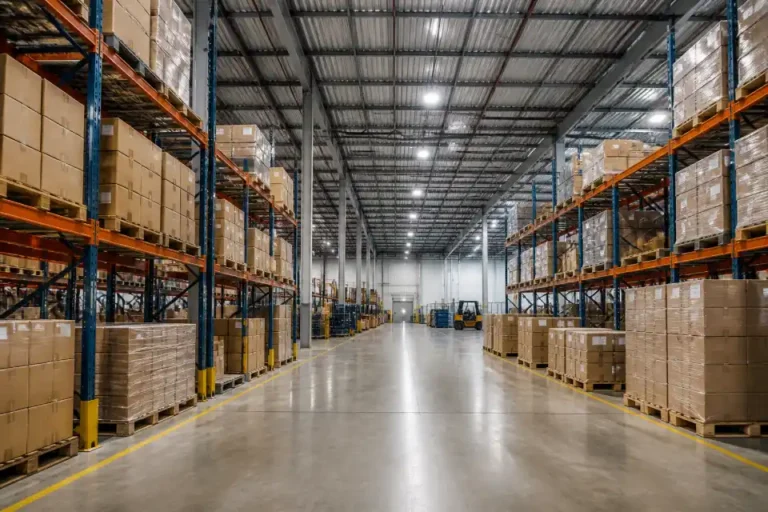
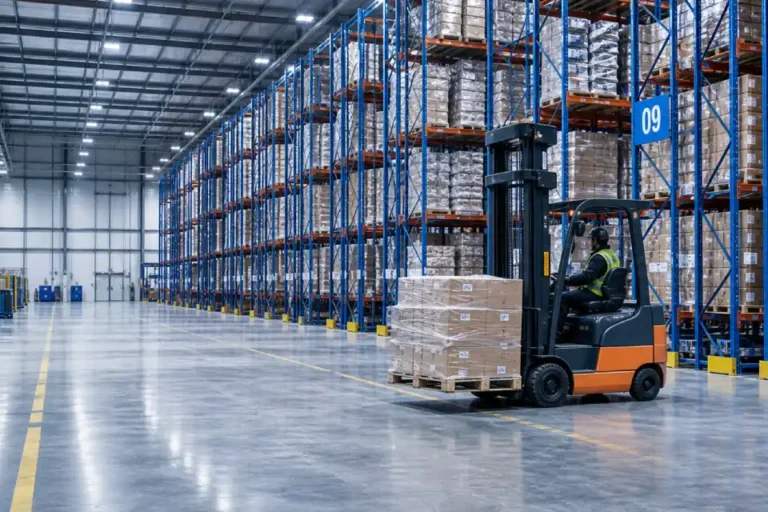
Selective racking is the standard pallet rack layout: uprights and beams create individual shelf levels, and each pallet gets its own position accessed straight from the aisle. A forklift never enters the rack structure itself.
Every pallet is reachable at any time without moving another pallet out of the way. That direct access is the tradeoff for needing far more aisle space than a high density system, since each row requires its own forklift aisle rather than sharing one across a block.
Drive-in racking’s biggest strength is also its biggest constraint: density comes from giving up individual pallet access, so the system rewards some inventory profiles and punishes others.

Drive-in racking runs on last in, first out rotation, while selective racking supports first in, first out and random access equally well. Your rotation requirement, not your space constraint, is usually the deciding factor between the two systems.
Perishable, date coded, or expiration sensitive inventory generally needs FIFO rotation, which points toward selective racking or a drive through configuration. Non-perishable, uniform inventory that moves in full batches works fine with LIFO, which is exactly what drive-in racking is built for.
Mixing the two requirements in a single lane is where most drive-inracking mistakes happen. If a lane holds even a small amount of date sensitive stock behind newer pallets, that older stock can sit untouched until the whole lane empties, which defeats the point of tracking expiration dates at all.
Drive-in racking delivers the highest storage density and the lowest cost per pallet position, while selective racking delivers the highest accessibility and SKU flexibility. Choose drive-in racking for large volumes of a few products, and selective racking when you need direct access to many different products.
| Attribute | Drive-in Racking | Selective Racking |
| Pallets deep per lane | 4 to 10 | 1 |
| Selectivity | Low, LIFO access only | Full, direct access to every pallet |
| Inventory flow | LIFO | FIFO or random access |
| Space utilization | 85 percent or higher | Roughly 40 to 50 percent |
| Aisle requirement | One main forklift aisle per block | One aisle per row |
| Best for | Low SKU count, high volume, bulk storage | High SKU count, frequent picking |
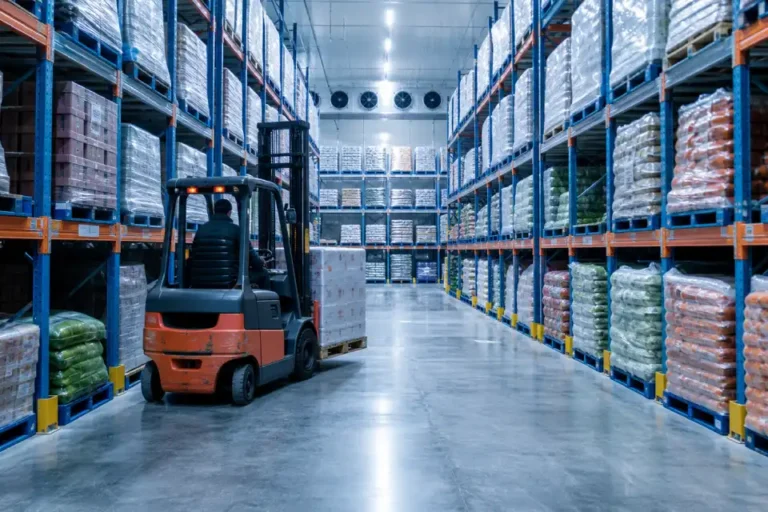
Drive-in racking suits operations storing large, uniform pallet quantities of a small number of SKUs. Beverage distributors, frozen food warehouses, and manufacturers holding bulk batches of one product are the classic fit, including cold storage racking systems where minimizing refrigerated air volume matters as much as pallet count.
Selective racking suits operations with many different SKUs and frequent picking. Retail distribution centers, mixed product warehouses, and any facility where direct access to every pallet drives daily operations depend on this system despite its lower density.
Match your inventory profile to the system, not the other way around. If you carry dozens or hundreds of active SKUs with weekly picking, selective racking is almost always the right call despite its higher cost per position.
If a small number of products make up most of your pallet count and each one moves in and out as a full batch, drive-in racking turns that pattern into a real advantage, since you stop paying for selectivity you never use. Many facilities run both systems in different zones rather than forcing one system to cover every product.
Switching between racking types changes how the building itself needs to perform, not just how the product gets stored.
None of these considerations should rule out the denser option. They just need to be part of the decision before installation, not a surprise change order after the racking arrives.
Counting SKUs and turnover on paper only gets you so far. A short conversation with someone who has sized both systems for real warehouses usually surfaces constraints, like ceiling height or dock layout, that change the answer.
Funya’s team reviews your pallet count, SKU mix, and rotation needs before recommending a system, rather than starting from a preferred product. If you want a second opinion on which system fits your space, reach out to our engineering team with your warehouse dimensions and inventory profile.
drive-in racking operates on a last in, first out basis, since pallets load and unload from the same end of the lane. Operations needing strict FIFO rotation typically choose a drive through configuration or selective racking instead.
Yes. Many warehouses run selective racking for high SKU count, frequent pick product while dedicating drive-in bays to their highest volume, lowest SKU items. Mixing systems by zone is common and often the most cost effective layout.
It depends on SKU count more than temperature. Drive-in racking wins for bulk, low SKU frozen storage because it minimizes the refrigerated volume that has to be cooled, while selective racking still makes sense for cold storage SKUs that need individual access.
Drive-in racking typically costs less per pallet position at scale, since fewer aisles and fewer beam levels are needed for the same pallet count. Selective racking costs more per position but avoids the honeycombing and access limits that come with deep lane storage.
The choice between drive-in racking and selective racking is not about which system is better. It is about which one matches your SKU count, turnover rate, and rotation needs.
Count your active SKUs, confirm whether FIFO rotation is required, and calculate how much of your footprint is aisle space versus product. drive-inracking rewards bulk, low SKU operations with density. Selective racking rewards high SKU, high turnover operations with access. Share your pallet count and product mix, and we can help you size a layout that fits either system, or both.
Not sure which one fits your warehouse? Send us your pallet count and SKU mix and our team will help you size the right layout, at no cost.