Phone:
(86)138-1388-1779
Physical address:
6296 Donnelly Plaza
Ratkeville, Bahamas.

Phone:
(86)138-1388-1779
Physical address:
6296 Donnelly Plaza
Ratkeville, Bahamas.
In the world of 3PL (Third-Party Logistics) and distribution centers, the question isn’t “which racking is best?” but rather “which racking is best for THIS inventory?”
Choosing the wrong logistics racking system can lead to millions in wasted real estate and crippled throughput. Let’s dive deep into the three most critical systems for logistics: Selective, Drive-In, and Push-Back.
Warehouse design is governed by a simple inverse relationship. As you increase storage density (more pallets per square meter), you decrease selectivity (the ability to access any given pallet immediately). Your job is to find the sweet spot for your inventory profile.
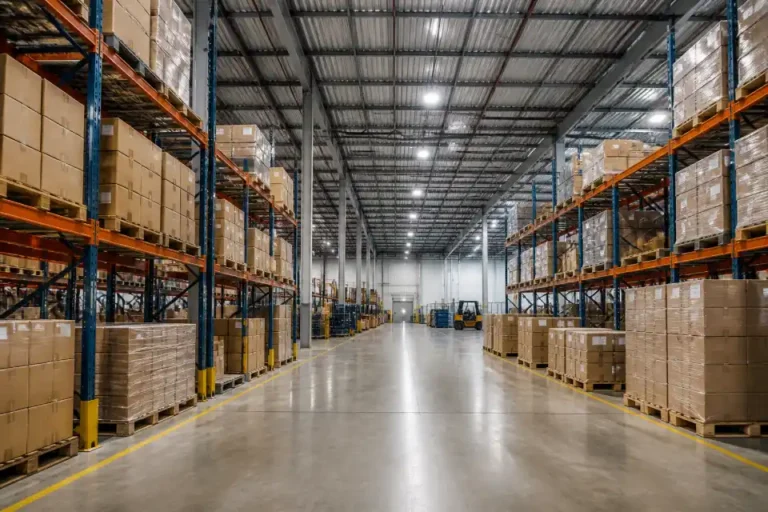
This is the most common system globally. It consists of vertical frames and horizontal load beams, creating wide aisles for forklifts.
Drive-In systems eliminate aisles. Forklifts actually drive *into* the rack structure to place pallets on continuous rails.
Push-Back racking uses nested carts on inclined rails. When a new pallet is loaded, it pushes the previous pallet back. When retrieved, the pallet rolls forward via gravity.
| Feature | Selective | Drive-In | Push-Back |
|---|---|---|---|
| Storage Density | Low | Very High | High |
| Selectivity | 100% | Low (by lane) | Medium (by lane) |
| Inventory Flow | FIFO/LIFO | LIFO | FIFO |
| Forklift Skill | Basic | Advanced | Intermediate |
| Floor Utilization | ~35% | ~65% | ~55% |
For modern logistics, density isn’t just about the racking. Combining these systems with Multi-Tier Mezzanine Floors can triple your usable space. By creating a second or third level of picking, you can use selective racking on the ground for fast movers and dense systems above for bulk storage. This is particularly effective in e-commerce fulfillment centers where you need to pick individual cartons as well as full pallets.
Let’s calculate. Suppose your warehouse rent is $10 per square meter per month. You have 1,000 sqm of space.
By switching to Drive-In, you save $6 per pallet per month. On 2,500 pallets, that’s $15,000/month in saved rent. Even if the Drive-In system costs $50,000 more upfront, it pays for itself in just over 3 months.