Phone:
(86)138-1388-1779
Physical address:
6296 Donnelly Plaza
Ratkeville, Bahamas.

Phone:
(86)138-1388-1779
Physical address:
6296 Donnelly Plaza
Ratkeville, Bahamas.
Warehouse pallet racking can suitable for forklift working.
There are two kinds of aisles can be chosen, One is normal aisle about 3000mm;
The other one is about 1700mm which require special forklift to fetch.
A single block of drive-in racking can hold nearly twice as many frozen pallets as the same footprint of standard shelving, without adding a single square meter to your building. That density is why drive-in racking for cold storage has become a default choice for warehouses that store large volumes of a limited number of products at low temperatures.
Every aisle removed from a freezer is refrigerated air your compressors no longer have to cool.
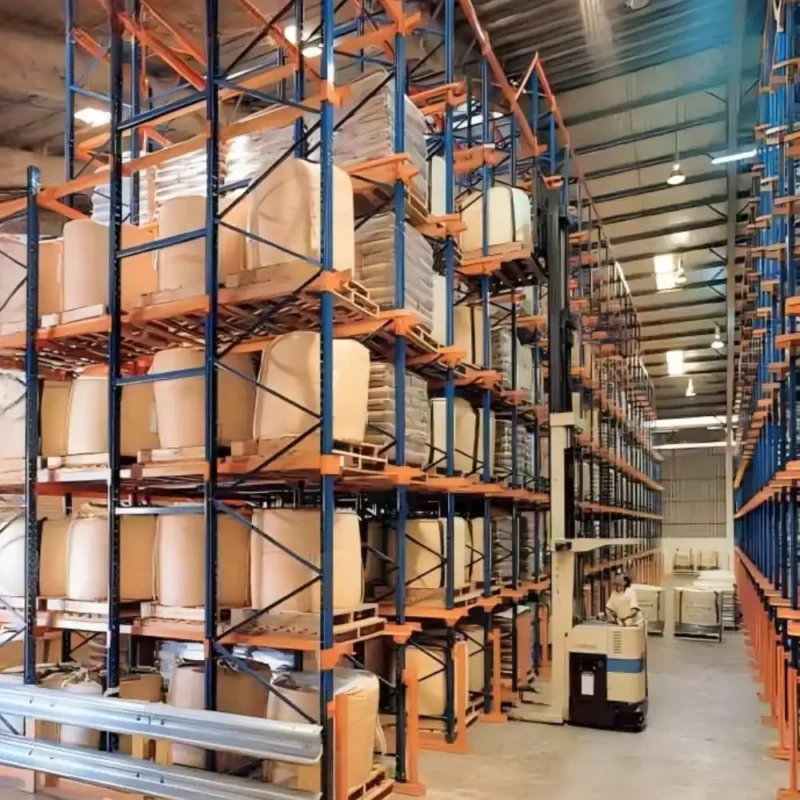
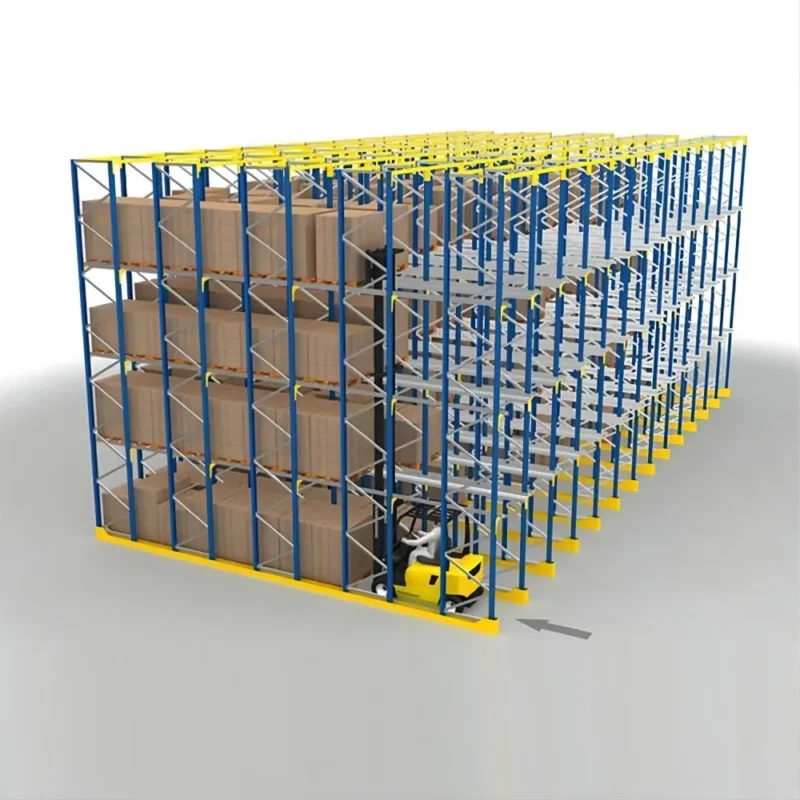
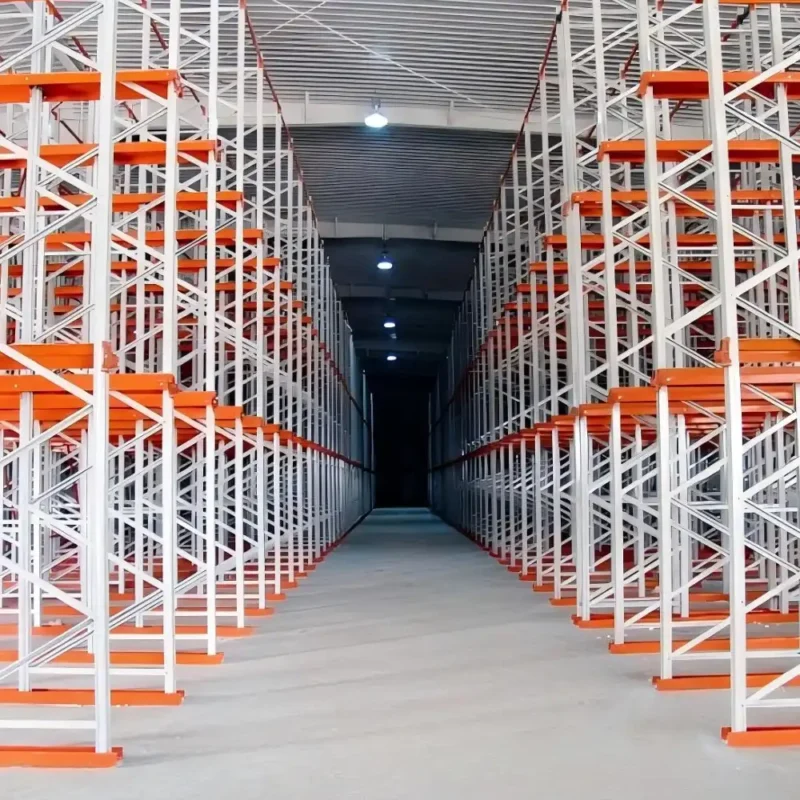
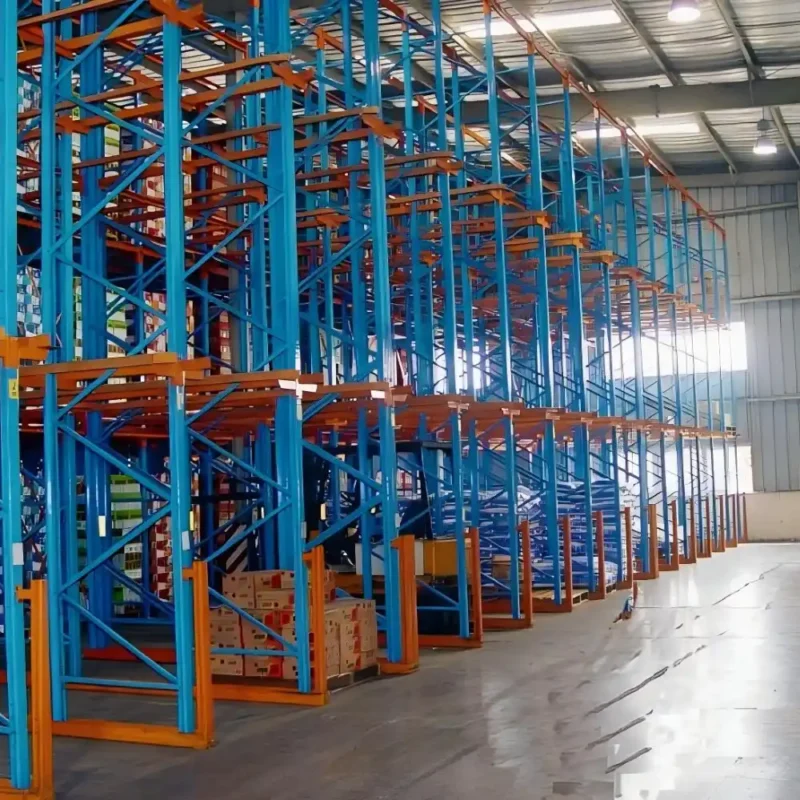
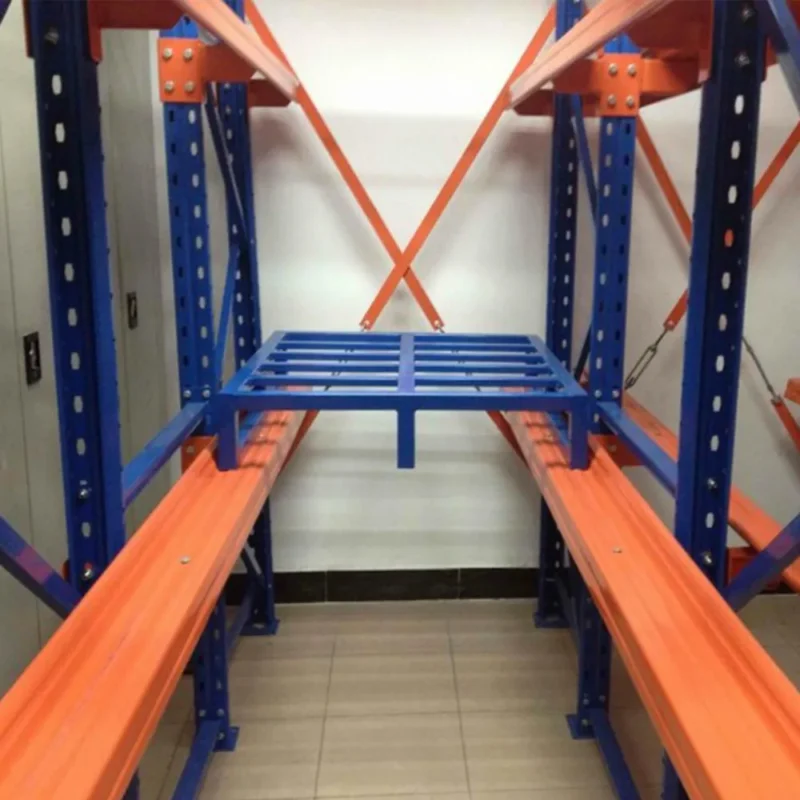
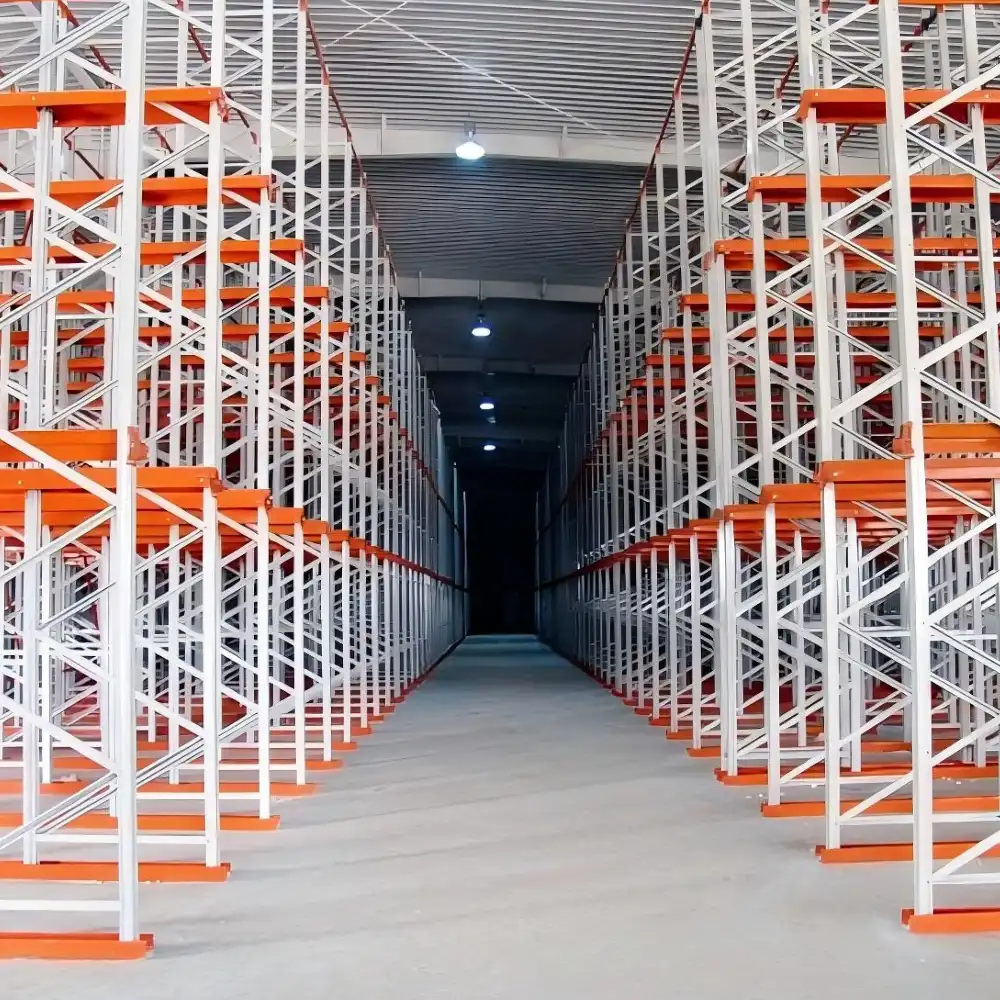
A forklift enters the rack structure directly instead of working from a fixed aisle. Pallets rest on continuous support rails that run the depth of the lane, typically 4 to 10 positions, rather than on individual crossbeams at each level.
Loading and retrieval happen from the same end of the lane, so the system runs on a last in, first out basis. One forklift aisle can serve an entire block of drive-in racking systems, which is the structural reason it reaches such high density compared with row by row selective racking.
Drive-in racking fits cold storage because it removes most aisles from the refrigerated envelope, which cuts the air volume your compressors have to cool and lowers energy cost per pallet stored. It also reaches space utilization above 85 percent, well ahead of selective racking in the same footprint. The main advantages for cold storage operators include:
●Storage density above 85 percent space utilization, since cross aisles are almost entirely removed
●Lower energy spend per pallet, because less refrigerated air volume needs to be cooled and held at temperature
●Lower building cost per pallet position, since a smaller refrigerated envelope holds the same throughput
●Corrosion resistant finish options suited to condensation, frost, and high humidity inside a cold room
●Best fit for low SKU, high volume storage, such as bulk batches of a single frozen product moving in and out together
●Space utilization up to 85 percent or more compared with selective racking
●Last in, first out handling suited to bulk, batch based storage
●Lane depth from 4 up to 10 pallet positions
●One forklift aisle serves the entire rack block, reducing refrigerated floor space
●Lane depth and rack height are specified per project, not fixed to a single size
●Finish options engineered for condensation and frost resistance in cold rooms
●Lower cost per pallet position than selective racking at high storage volumes
●Compatible with standard counterbalance and reach forklifts
| Specification | Detail |
| Rack type | Drive-in racking, single deep or double wide configurations |
| Load capacity per pallet | 500 to 2,500 kg (confirmed per project through load calculation) |
| Lane depth | 4 to 10 pallet positions |
| Rack height | Up to 12,000 mm |
| Upright profile | Heavy duty 120 by 95 mm or larger |
| Support rail | Heavy duty cold formed channel rail (4# / 5#) |
| Aisle requirement | One main forklift aisle |
| Space utilization | 85 percent or higher |
| Structural steel | Q235B |
| Recommended finish for cold storage | Hot dip galvanizing |
| Operating range | Approximately −28°C to +40°C for freezer and chilled storage |
| Safety accessories | Entry collision posts, end guards, top tie mesh |
Q235B structural steel performs reliably across this operating range on its own. The variable that determines how a rack holds up in a cold room is the surface finish, not the base steel grade. Hot dip galvanizing resists corrosion better than powder coating under constant condensation, so it is the recommended specification for cold storage and freezer rooms. Powder coating stays a suitable, more economical option for ambient warehouses only.
Beams are available in step, box, and tube profiles, engineered to a deflection ratio under 1 over 250, with weight varying by size and length. Full beam weight tables are available on request as part of the project specific load calculation.
Drive-in racking trades per pallet selectivity for the highest storage density of the three systems, which is why it suits low SKU, high volume cold storage best. Selective racking gives full access to every pallet at the cost of density. Push back racking sits between the two, offering more selectivity than drive-in with a smaller density gain.
| Attribute | Drive-in | Selective | Push Back |
| Pallets deep | 4 to 10 | 1 | 2 to 6 |
| Selectivity | Low, last in first out access only | Full, direct access to every pallet | Moderate, front loaded access per lane |
| Inventory flow | LIFO | FIFO or random access | LIFO |
| Required truck | Counterbalance or reach truck | Any standard forklift | Counterbalance or reach truck |
| Best for | Low SKU, high volume bulk cold storage | High SKU variety, frequent picking | Mid density storage needing more selectivity than drive-in |
If you are still weighing which system fits your inventory profile, our guide on selective versus drive-in versus push back racking breaks down the decision in more depth, including cost per pallet position and how SKU count should drive the choice.
Drive-in racking suits any refrigerated or frozen operation storing large, uniform pallet quantities of a limited number of SKUs, where density matters more than picking every pallet individually. Common applications include:
●Frozen food storage
●Cold chain logistics
●Beverage and FMCG distribution
●Dairy and meat cold rooms
●Pharmaceutical cold storage
●Chemical raw material storage
●Seafood and produce storage
Funya is a direct manufacturer of drive-in racking, not a reseller. Every system is cold formed, welded, and finished in house, so lane depth, upright profile, and load rating match your project rather than a fixed catalog size.
Every project starts with 2D and 3D CAD layout drawings built around your warehouse dimensions, followed by a load calculation specific to your pallet size, load weight, and clear height, covering upright, beam, and rail capacity for that layout.
Structural design follows EN 15512:2020 and GB/T 39830-2021 standards. On request, we provide ISO certification, material mill reports, load testing records, and welding inspection documents for compliance verification before installation. This same process supports our Cold Storage and Freezer Solutions line, where finish and steel grade are matched to your operating temperature.
Drive-in racking is a high density pallet storage system where forklifts drive into the rack structure and place pallets on continuous support rails instead of individual beam levels. One forklift aisle serves the whole block of lanes instead of an aisle per row, which is what creates the density gain.
Yes. With a hot dip galvanized finish, drive-in racking resists the corrosion, condensation, and frost common in freezer rooms while still delivering the density those facilities need. The steel performs across a typical range of about −30°C to +5°C.
Standard drive-in racking operates on a last in, first out basis, since pallets load and unload from the same end of the lane. Operations needing strict FIFO rotation typically use a drive through configuration instead.
Load capacity is not a single published number. It depends on lane depth, upright profile, and support rail size, so each project gets a load calculation matched to your actual pallet weight and layout.
Drive-in systems work with standard counterbalance forklifts and reach trucks. Because the truck operates inside the rack structure rather than in an open aisle, operators should be trained for the reduced clearance, and entry collision posts should be specified to protect the structure from impact.
Drive-in racking for cold storage delivers the highest storage density available when a refrigerated warehouse needs to store large volumes of a small number of SKUs without expanding its footprint. Removing aisles cuts the air volume that has to be cooled and, with the right finish, holds up to years of condensation, frost, and washdown cycles.
It is not the right fit for every operation. High SKU, fast rotation inventory is usually served better by selective or push back systems. For bulk, low SKU cold and frozen storage, drive-in racking consistently delivers the strongest density per refrigerated square meter.
Share your warehouse dimensions, pallet size, and load weight, and our engineering team can turn that into a layout and load calculation specific to your project.